A Note on Links: When reading back posts, please be aware that links have a short half-life. You can find working links to all of the MHS resources on our Educator Resources Page.

Monday, April 22, 2019

Native Knowledge 360 Summer Teacher Institute


Native Knowledge 360° (NK360°) is the National Museum of the American Indian's national initiative to inspire and support transformative teaching and learning about American Indians. NK360° offers dynamic educational resources and professional development opportunities for educators. 
They are recruiting educators--especially those whose primary teaching focus is within the social studies, English language arts, or library sciences and who work with students in grades 4–12--to apply for their Summer Teacher Institute, which will be held July 9-11, 2019. The Institute is designed for education professionals (teachers, teacher educators, instructional coordinators/curriculum specialists, librarians/media specialists) who recognize a need for, and are interested in advancing their practice of incorporating more complete narratives about American Indian histories, cultures, and contemporary lives into their teaching.


 Please click on the links to learn more about NK360° and the Institute. Visit their Educator Page to learn more or click on the application link to apply. 
Applications are due May 6. The institute is free of charge and housing and lunches will be provided for the duration of the institute. However, attendees are responsible for the cost of their travel to and from Washington, D.C. 

P.S. Closer to home, we're looking for a few great high school teachers to join our MHS Teacher Leaders in History program and attend our June summit in Helena. Applications are due May 5. Learn more about the Teacher Leaders program here.

Monday, April 15, 2019

Cool Stuff (Link Roundup)

Normally I try to have a theme for these posts, but it's April, and snowing as I type, and I have a list of cool stuff that I haven't gotten around to sharing so today is Teaching Montana History's equivalent of leftovers night, which hopefully provides a little something for everyone.

Sue Reynolds is the founder of the new free Everyday Native 4th-12th grade teacher's resource. It's listed on OPI's website because it meets the Essential Understandings, is multi-subject and and includes the voices of Montana and other Native youth and their families and Victor Charlo's poems about his life. You have to register but it's free and worth exploring. 

Against the Darknessa film serving in tribute to the Montana coal miners, is available on YouTube!

I recently read Abaki Beck's report, "Ahwahsiin: The Land Where We Get Our Food, Traditional Ecological Knowledge and Contemporary Food Sovereignty on the Blackfeet Reservation." It's fascinating and I can imagine high school teachers using it as part of an interdisciplinary Geographic Inquiry. OPI's Indian Education Division Health Enhancement web page has more information on food sovereignty.

Speaking of geography, I was intrigued by this post by Larry Ferlazzo, an education blogger I follow: "Now This is Very Intriguing: Students & Teachers Can Now Create Their Own Google Virtual Reality ‘Tours’.” If any of you have used Tour Creator with your students, I'd love to hear from you!

Spring means baseball, and my Cardinals are at the top of the NL Central Division! And baseball, like football, still struggles with the issue of Indian mascots. Here's a good article to spark discussion around the issue: "Redface, like blackface, is a sin of white supremacy." And here's an article from the Missoulian that reports on research conducted by a UM professor, which empirically demonstrated that "Mascots Can Reinforce Stereotypes."   Finally, OPI Indian Education Specialist Mike Jetty recommends the website Change the Mascot, which he called his "go-to site for all things mascot related."

P.S. High School Teachers: If you are interested in helping improve history education in your schools, districts, and regions (particularly the teaching of Montana history), apply to attend our June Teacher Leader Summit and become a Montana Historical Society Teacher Leader in History. 

Monday, April 8, 2019

New IEFA Resources from the Montana Memory Project

Jennifer Birnel at the Montana Memory Project has created two new exhibits for classroom use:

Montana Native American Boarding Schools
Native American Leaders

Both exhibits are based on images that have been digitized by the Montana Memory Project. The exhibits are great in their entirety, but they are also a great way to find images of boarding schools or Indian leaders--and you can download and specific images by "right-clicking" (make sure to copy the provenance!)

With help from Mike Jetty at the Indian Education Division of the Office of Public Instruction, Jennifer has come up with some great discussion questions. I especially like the questions and context provided for the Indian Leaders exhibit. As Jennifer explains, the "image titles and descriptions in this presentation were supplied by the library, museum, or archive that shared the image with the MMP" and the titles and descriptions were often created by the original photographer. Because of this, "items may not be described in appropriate terms or without bias." She's come up with a great set of questions to help students think about the images, and titles, in context, including:
  1. What does it mean to catalog an item? Why does cataloging not take into account cultural rules?
  2. What terms in the description of Chief Big Rock in the Chippewa Cree
  3. section are inappropriate? Why? Can you find other terms in the image descriptions that are cause for
  4. concern? Why are they an issue? What could be done to improve the descriptions?
  5. Look specifically at the images of Chief Koostata of the Kootenai. Ask: Who Created it? For what purpose? When was it created (what context)? Why do you suppose the photographer took these specific images?
  6. Examine the image of Bear Chief in the Blackfeet section. The captions on the image was created by the photographer. Why would he have given this image that specific title? How would you correct it?
  7. Do these images perpetuate the stoic Indian stereotype? Can you find images of Native Americans smiling or laughing?
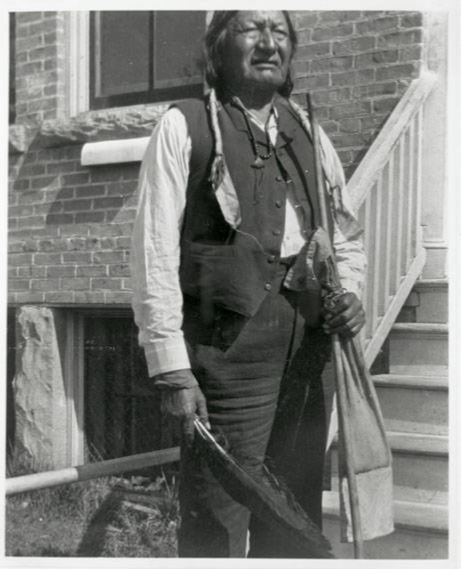
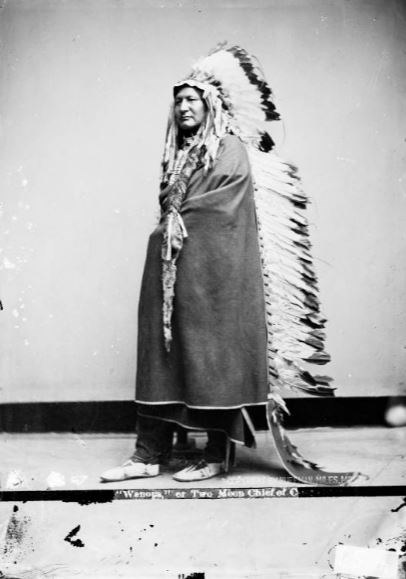
My favorite images in the Indian Leaders Exhibit are the ones that show the same leader in different contexts (for example, these pictures of Northern chief Two Moons--left, photo by William Harvey Harrison, c. 1910, University of Montana, 72.0749; right, photo by Stanley Morrow, c. 1878, Montana Historical Society, 981-172).


Both Jennifer and I are interested in how you use these exhibits, and how they could be made even more useful to you, so if you use either exhibit in your classroom, let me know how it goes!

P.S. High School Teachers: If you are thinking about applying to become an MHS Teacher Leader in History, can you let me knowLearn more about the program and the application process here or email me with questions.

Monday, April 1, 2019

Russell Tarr and "The Big Picture": Using pictures to help students get a sense of the, well, the big picture

Do you subscribe to Russell Tarr's blog, Tarr's Toolbox? I think you should. At any rate, I do, which is where I find some great strategies for improving student learning.

Back in November, I shared his Time Travel exercise (he has students write a vacation brochure promoting a trip to the past and then a complaint letter from an unhappy customer, talking about how the trip didn't live up to the hype).

Here's another Russell Tarr idea I think could easily translate to teaching Montana history, particularly in middle school: “The Big Picture”: convert a new topic into pictures, then the pictures into galleries.

Russell seems to shape a lot of his curriculum around investigating big questions: "Was industrialization good or bad?" for example. But before having students jump into answering a focus question, he sometimes uses images to help them see the "big picture," or larger context of a historic period.

At the beginning of the unit study, he provides
each student with a different image from a collection shared between the class (paintings, cartoons, photographs of buildings/artefacts/individuals) and challenge[s] them to interpret their meaning. Then, working in groups and then as a class, the students decide upon the best ways of categorising the images. Finally, each student conducts independent research to produce a panel of information to put alongside their own image before putting them all up to create an impressive classroom display.
He details how this works in his blog post, using the Victorian era as his example. The activity starts with quick gallery walk, so each student can see all of the images and decide which are their favorites. Then Russell used
the random name picker at ClassTools.net to select one student, who sat down at the chair in front of her favoured image. I then repeated this process until all students were seated alongside one image. All the students were then asked to consider what title they would give to the image, how they would describe it to someone else, and what deductions they could draw from it. These findings were exchanged in small groups, with other members of the team encouraged to offer further ideas to note down so that each student ended up with plenty of thoughts. For good measure I then jigsawed the groups to get a further round of discussion.
Finally he had students work as a whole class to categorize the images (with no less than three and no more than five images per category).
Once this process appeared complete, each team discussed what their images had in common and therefore what title they would give to their ‘section’ of the gallery exhibition we were working towards ('work', “leisure”, “children” being popular choices). The final stage of the exhibition task was for each student to research their image further and complete a writing frame to summarise their key findings.
 I can see this project working well with any number of Montana history topics. The trick, of course, is finding relevant and provocative images. Let's say you planning on having your class explore the overall theme of agriculture. Perhaps your guiding question is “How did agricultural settlement change Montana?” Or maybe “Was homesteading a great opportunity or a bad bet?” Or even "Was the Homesteading Act good for Montana?"
You can find more great teaching strategies for all grade levels over at Russell Tarr's site. Happy surfing!

This is the third in a series of posts I've been writing on teaching Montana history. See this earlier post on a jigsaw exploration of the fur trade and this one on time traveling back to the open range (expanding on a different strategy that Russell Tarr introduced me to).  If you have something that's worked especially well in your classroom, let me know and I'll share it out!


Wednesday, March 27, 2019

Reminders and Updates

Montana History Teacher of the Year Award

March 29--THIS FRIDAY--is the deadline for nominating someone for the Montana History Teacher of the Year Award. Luckily, completing the nomination takes under two minutes. To nominate a 4th-6th grade Montana History Teacher, email Norma Ashby at ashby7@q.com.  Please include the following information:

* Your name* Your email* Nominee’s name* Nominee’s email* Grade level* School Name* School  address* School phone number


High School Teachers: Apply to Become an MHS Teacher Leader in History

If you are a high school teacher interested in helping improve history education in your schools, districts, and regions (particularly the teaching of Montana history), we hope you'll consider applying to become a Montana Historical Society Teacher Leader in History. Learn more about the program and the application process here or email me with questions.


Crossing Disciplines Workshops

The winner and his or her class will be honored at a ceremony in the State Capitol on Friday, Nov. 8, Statehood Day and will receive a plaque and $4,000 toward library and classroom materials, field trips and speakers.

 There's still time to join Jim Schulz for "Crossing Disciplines: Social Studies and the Common Core" in Deer Lodge (April 9), Missoula (April 10), or Dillon (April 11.) The Missoula and Dillon workshops have plenty of registrants (though there's still some room in each); we may have to cancel the Deer Lodge workshop if more people don't sign up, so don't delay.


Montana Museum Act of 2020

SB 338, which will implement a 1% accommodations tax to provide funding for Montana Heritage Center renovation and expansion of the Montana Historical Society over 5 years, create a museums/historic sites infrastructure competitive grant program of over $2 million per year, and provide funding for the Daly Mansion and Moss Mansion among other things passed out to the Senate Finance and Claims Committee on a vote of 10-9. It now heads to the Senate floor and then onto the House. You can contact your representatives about this or any bill using this easy online form. Not sure who represents you? Find out here.

Montana History in 9 MORE Easy Lessons 

This nine-part lecture series starts next Wednesday, April 3, with Jessica Bush talking about pre-contact trade. Last year, for our first edition of 9 Easy Lessons, Jessica gave an overview of pre-contact Montana and it was eye-opening. You can find that talk on YouTube if you want to get prepped for the upcoming series (and, after watching you can take the quiz for OPI renewal units). Just as we did last year, we'll once again be live-streaming the lectures (and then posting them on YouTube) for folks who can't make the talks in Helena. And we'll be offering a mechanism to receive renewal units too. 

Monday, March 25, 2019

Montana History in 9 MORE Easy Lessons


Last spring we created a lecture series we called Montana History in 9 Easy Lessons. For nine weeks in March and April we asked colleagues to discuss a major period in Montana history. Individually, these programs offered compelling discussions of specific topics relating to Montana’s past; together they provided a big-picture overview of the state’s rich and fascinating history. To make the material accessible statewide, we live-streamed their talks and made recordings available after the fact on YouTube. And to better serve teachers, we also created a simple reflection form for educators to complete after watching one of the presentations so that they can to receive renewal units.

Why do I bring this up now? Montana History in 9 Easy Lessons was so popular we decided to reprise the series. For nine Wednesdays, 3:30-4:30, beginning April 3, we'll be presenting Montana Lessons in 9 MORE Easy Lessons, filling in some of the gaps we left from the first big sweep. Once again, we'll be live-streaming and archiving all lectures on YouTube, and once again, educators will be able to receive renewal units for "attending" the lecture and submitting their thoughts via our reflection form. You can find full descriptions and (as ultimately YouTube links) on the 9 More Easy Lessons webpage, but to whet your appetite, here is the list of topics: 

April 3: Pre-contact Trade, Jessica Bush, State Historic Preservation Office Review and Compliance Officer for the Montana Historical Society 

April 10: Montana's Early Fur Trade in the Wake of Lewis and Clark,  Jim Hardee, former editor of Rocky Mountain Fur Trade Journal 

April 17: The Rise and Fall of Open Range Cattle Raising on the Montana Plains, Vic Reiman, retired MHS Museum Technician

April 24: Do Treaties Matter? OPI Indian Education Specialist Mike Jetty 

May 1: Dreams and Dust: Montana during the Great Depression, Montana State University Distinguished Professor Mary Murphy

May 8: Copper, Commies, and the Cold War: Montana’s Labor Resurgence, 1934-1950, Montana Historical Society Senior Manuscript Archivist Rich Aarstad 

May 15: Montana during the Relocation and Termination Era, Montana The Magazine of Western History Associate Editor Laura Ferguson 

May 22: On the Road Again, Montana Department of Transportation Historian Jon Axline

May 29: Montana in the Last Third of the Twentieth Century. University of Montana Professor Emeritus Harry Fritz  

P.S. If you live anywhere near Deer Lodge, Missoula, or Dillon, don't forget to register for our upcoming workshops. Jim Schulz (who is, no kidding, among the best workshop leaders I've ever encountered) will be taking "Crossing Disciplines: Social Studies, Art, and the Common Core" to Deer Lodge on April 9, Missoula on April 10, and Dillon on April 11. Find more information and a link to register here. And if you could let your colleagues know about these opportunities, that'd be a great help.

Monday, March 18, 2019

High School Teachers: Apply to Become an MHS Teacher Leader in History


Two years ago we started an Elementary Teacher Leaders in History program, and last year we added middle school teachers. It's gone so well that this year we're soliciting applications from high school teachers to participate in the program. 

If you are interested in helping improve history education in your schools, districts, and regions (particularly the teaching of Montana history), consider applying to become a Montana Historical Society Teacher Leader in History

Successful applicants will demonstrate a commitment to history education, interest and experience in teaching Montana history, excellence in the classroom, experience in sharing best practices with their colleagues, and familiarity with the Montana Historical Society’s work and educational resources.

In addition to the criteria above, program fellows will be chosen to reflect Montana’s geographic and educational diversity, assuring representation from different regions and both small and large schools.

Those accepted as high school Teacher Leader Fellows will be brought to Helena for a two-day Teacher Leader in History Summit, to be held at the Montana Historical Society, June 24-26, 2019, at the conclusion of which they will be certified as Montana Historical Society Teacher Leaders in History. (Note: These dates have changed.)

Throughout 2019-2020, this select group of Teacher Leaders in History will:
  • Serve as members of the Montana Historical Society Educator Advisory Board, providing advice and classroom testing of lesson plans on an as-needed basis.
  • Work to increase the Montana Historical Society’s visibility in their schools and communities.
  • Assist other teachers in their schools in finding appropriate resources/implementing lessons that reflect best practices in history education.
  • Promote Montana Historical Society resources to other teachers through a formal presentation at one or more regional conferences (for which they may earn OPI Renewal Units)
  • Promote Montana Historical Society resources within their own school or across their district through informal outreach and/or formal presentations
  • Communicate with Montana Historical Society staff throughout 2019-20, documenting the outreach they have conducted and participating in up to three one-hour virtual meetings (scheduled at mutually agreeable times).

 In return, the Montana Historical Society will provide the following:
  • Full travel scholarships to attend the free two-day June 2019 Summit.
  • An honorarium of $100 to cover travel expenses to one regional conference, at which the participant is presenting, or up to $100 to your school to pay for a substitute teacher so you can present in a nearby district.
  • Ongoing support and consultation, including model PowerPoint presentations to use and adapt as in presentations to fellow educators.
  • A certificate designating the participant as an official MHS Teacher Leader in History.
  • Up to 15 OPI Renewal Units or 1 graduate credit (at the cost of $150/pending course approval from MSU-Northern.)  
Although preference will be given to teachers who teach Montana history, English teachers and librarians (or other subject area teachers who incorporate significant amounts of Montana history into their curriculum) are invited to apply. No more than ten teachers will be selected for this special program. Apply online here. Applications are due May 5. Awardees will be notified by May 10.